UNS N08031 (Alloy 31) Forging Parts | China Jiangyin Manufacturer
Jiangsu Liangyi Co., Limited has manufactured UNS N08031 (Alloy 31 / 1.4562) forgings since 2005. Our Jiangyin facility covers 80,000 m² and runs a 6,300-ton hydraulic press, a 5-meter ring rolling mill, and 10 atmosphere-controlled heat treatment furnaces. Single-piece capacity runs from 30 kg to 30,000 kg; seamless rolled rings are available to 6 m OD. We hold ISO 9001:2015 certification. Forgings are manufactured and tested to API 6A, ASME, NACE MR0175 and PED 2014/68/EU requirements on client specification. Every shipment includes an EN 10204 3.1 or 3.2 mill test certificate. All forging, heat treatment and CNC machining is done in-house; no production steps are sub-contracted.
1997Year established
2005First N08031 order
6,300 tHydraulic press
5 mRing rolling mill
6 m OD maxSeamless ring
30 – 30,000 kgSingle-piece range
300+N08031 projects
50+ countriesExport markets
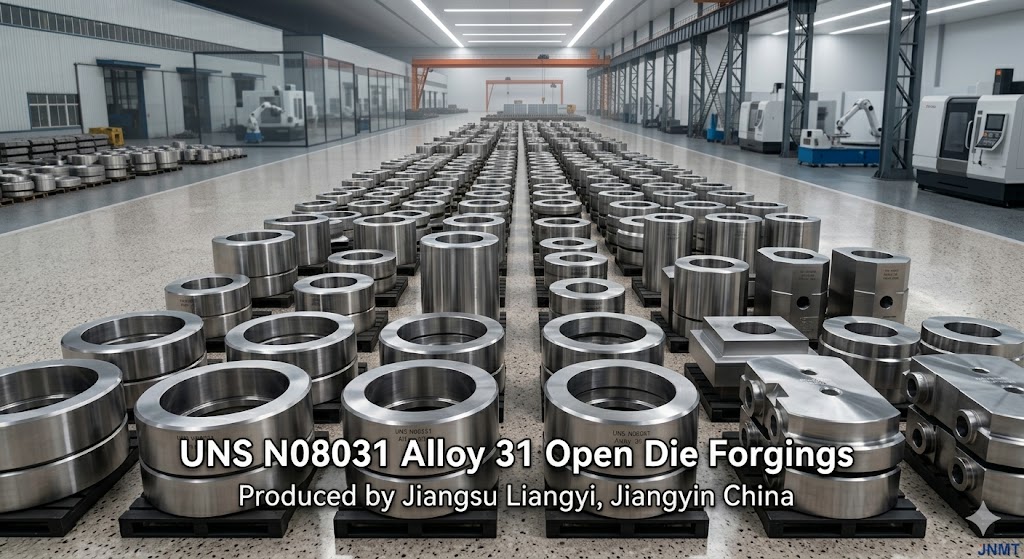
UNS N08031 Alloy 31 Open Die Forgings
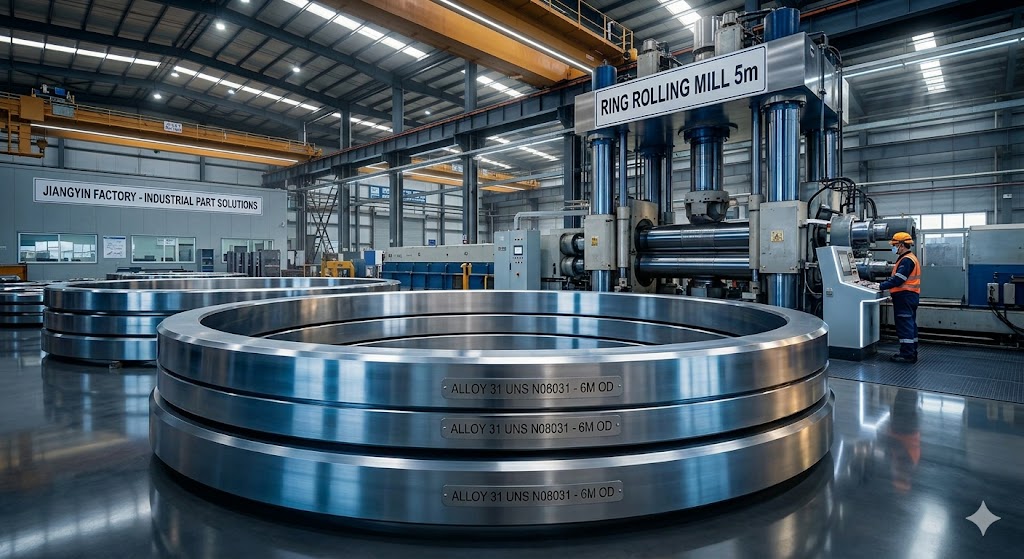
Alloy 31 Seamless Rolled Rings – to 6 m OD
UNS N08031 (Alloy 31 / 1.4562): Material Overview
UNS N08031 is a super austenitic stainless steel containing nominally 27% Cr, 31% Ni, 6.5% Mo, 0.20% N and 1.2% Cu. Its Pitting Resistance Equivalent Number (PREN = %Cr + 3.3×%Mo + 16×%N) reaches a minimum of 48, placing it above 254SMO (PREN ∼43) and well above 904L (PREN ∼33). Relative to Hastelloy C-276, it costs roughly half as much per kilogram of forging stock while covering the majority of sour gas, mixed acid and FGD service environments.
The 1.0 – 1.4% copper addition gives N08031 its resistance to reducing acids. In sulfuric and phosphoric acid streams, copper shifts the corrosion potential into the passive region — a mechanism that high-Mo, low-Cu grades such as 254SMO don't replicate reliably above about 50% H₂SO₄ concentration. The 0.15 – 0.25% nitrogen strengthens the austenite matrix and delays sigma-phase formation during hot forging, which affects dimensional and microstructural consistency in large-section components.
Forged vs. Bar or Plate
Hot forging of N08031 refines the as-cast grain structure, closes ingot porosity, and aligns grain flow with the part geometry. For pressure-retaining components in sour or acid service, the worked microstructure reduces susceptibility to stress corrosion cracking at grain boundaries. Our press forgings are solution annealed at 1,149 – 1,177 °C and water quenched, consistently producing an ASTM grain size of 5 – 7 with no detectable delta ferrite or sigma phase on metallographic examination.
Cross-standard designations:
UNS N08031 (Alloy 31) – Designation Equivalents by Standard
Standard / System
Designation
Notes
UNS (USA)
N08031
ASTM/ASME primary reference
EN / DIN (Europe)
1.4562
Used in DIN 17458, EN 10088
VDM Metals GmbH
VDM Alloy 31™
Registered trade name; cited for equivalence only
ThyssenKrupp VDM
Nicrofer 3127 hMo™
Legacy trade name; cited for equivalence only
Outokumpu
Cronifer 3127 hMo™
Trade name; cited for equivalence only
JIS (Japan)
NCF 31J1
Approximate equivalent; verify against JIS G4901
VDM Alloy 31 is a trademark of VDM Metals GmbH. Nicrofer 3127 hMo is a trade name of ThyssenKrupp VDM. Cronifer 3127 hMo and 254SMO are trade names of Outokumpu Oyj. All trade names are referenced for technical equivalence identification only. Jiangsu Liangyi Co., Limited has no affiliation with these companies.
UNS N08031 vs. Common CRA Alternatives: Key Parameters
The table compares N08031 against grades that typically appear in the same specification discussions. Material cost multipliers are relative to 316L ingot stock quoted to Jiangyin-based buyers; finished part pricing varies with geometry and quantity.
UNS N08031 Alloy 31 vs. Competing CRA Grades – Engineering Selection Data
Parameter
316L (S31603)
904L (N08904)
254SMO (S31254)
Alloy 20 (N08020)
N08031 Alloy 31
C-276 (N10276)
Ni (%)
10 – 14
23 – 28
17.5 – 18.5
32 – 38
30 – 32
≥ 57
Cr (%)
16 – 18
19 – 23
19.5 – 20.5
19 – 21
26 – 28
14.5 – 16.5
Mo (%)
2 – 3
4 – 5
6 – 6.5
2 – 3
6 – 7
15 – 17
N (%)
0.10 max
0.10 max
0.18 – 0.22
—
0.15 – 0.25
—
Cu (%)
—
1.0 – 2.0
—
3.0 – 4.0
1.0 – 1.4
—
PREN (min.)
∼24
∼33
∼43
∼30
≥ 48
≥ 70
Critical pitting temp. (°C, 6% FeCl₃)
<0
∼15
∼35
∼20
∼45
>80
H₂SO₄ resistance
Poor – Limited
Good – Moderate
Good – Moderate
Excellent
Excellent
Excellent
HNO₃ resistance
Good
Good
Good
Fair
Excellent
Fair – Poor
Sour service (NACE MR0175)
Not qualified
Conditional
Conditional
Qualified
Qualified
Qualified
Min. Rp0.2 (MPa)
170
220
310
241
276
283
Forgeability (>500 kg section)
Excellent
Good
Moderate
Good
Good
Moderate – Difficult
Material cost vs. 316L
1× (base)
∼3×
∼4×
∼3.5×
∼4.5×
∼9 – 11×
Grade selection guidance: For pure chloride environments below 35 °C with PREN requirements below 40, 254SMO is often adequate at lower cost. In reducing acid service (H₂SO₄ above 10% concentration, phosphoric acid, mixed acids), N08031's copper addition provides corrosion resistance that Mo and Cr alone don't match. For HF service or environments requiring Mo above 10%, C-276 is the appropriate choice. N08031 covers sour gas, mixed acid, FGD and phosphoric acid heat exchanger applications at about half the material cost of C-276.
UNS N08031 Alloy 31: Forged Product Forms Available
All forging and heat treatment is done in-house. Dimensional tolerances are confirmed against client drawings at quotation; we don't apply blanket "forging tolerance" without written agreement. Available product forms:
Alloy 31 Seamless Rolled Rings — Cylindrical, contoured and gear-profile rings; OD 200 mm to 6,000 mm; ASTM A484 / EN 10243 tolerances unless otherwise agreed
UNS N08031 Forged Shafts and Spindles — Straight, stepped and flanged; valve stems, turbine and pump shafts; straightness ≤ 1.0 mm/m standard
Alloy 31 Hollow Forgings — Hubs, housings, thick-wall cylinders, sleeves; ID bored in-house; concentricity per drawing
UNS N08031 Forged Flanges and Blanks — Weld neck, blind, spectacle blind, double studded adapter; ASME B16.5 / B16.47 available
Alloy 31 Forged Discs, Tube Sheets and Baffle Plates — Tube sheets to 3,000 mm diameter; drilling per heat exchanger drawings on request
UNS N08031 Pressure Vessel Shells and Hollow Cylinders — For reactors and autoclaves; ASME BPVC Section VIII documentation available
For adjacent grades including Incoloy 825, Hastelloy C-276, Inconel 625 and Monel 400, see our nickel alloy materials page.
Hastelloy is a trademark of Haynes International, Inc. Inconel, Incoloy and Monel are trademarks of Special Metals Corporation. All trade names are referenced for product identification only. Jiangsu Liangyi Co., Limited has no affiliation with these companies.
Applications and Project References
Oil and Gas — Sour Service Wellheads and Valve Components
N08031 qualifies under NACE MR0175/ISO 15156 for H₂S and high-chloride environments. In the solution-annealed condition, hardness falls at 160 – 200 HBW — below the 220 HBW limit required for sour service. The high Cr-Mo-N passive film resists sulfide stress cracking (SSC) at cathodic polarization conditions. We supply forged valve bodies, bonnets, stems, seats and spool bodies to API 6A and API 6D dimensional requirements. In , we delivered 200+ wellhead forging sets to a UAE sour gas field project; the components have been in service for four years without material-related shutdowns.
Selection note: NACE MR0175 sour service requires both low hardness and adequate pitting resistance. N08031 in the solution-annealed condition meets both criteria without requiring cold work or precipitation hardening that would compromise one or the other.
Chemical Processing — Sulfuric and Phosphoric Acid Service
In H₂SO₄ and H₃PO₄ service, corrosion proceeds primarily by anodic dissolution. The 1.0 – 1.4% Cu in N08031 shifts the corrosion potential into the passive region in both acid types simultaneously; high-Mo grades without copper don't reliably achieve this above approximately 50% H₂SO₄ concentration. We manufacture forged tube sheets, reactor nozzles and pressure vessel shells for chemical plants, refineries and ore digestion facilities. In , we supplied forged tube sheets and reactor nozzles to a German chemical plant's sulfuric acid ore digestion system, replacing 316L components that had corroded through in under 12 months. Ultrasonic inspection at 36 months showed no measurable wall loss on the N08031 parts.
Nuclear Power — Reactor Coolant Pump Components
Nuclear service requires full material traceability from ingot heat to finished part, maintained for the plant lifetime. We assign a heat code at ingot receipt, carry it through every forging, heat treatment and machining record, and deliver it on the EN 10204 3.2 MTC. In , we supplied pump impellers and casings to a nuclear power plant project in Pakistan, qualified to ASME BPVC Section III and witnessed by TÜV Rheinland. The full documentation set ran from ingot certificate to final dimensional report in a single traceable package.
Power Generation — Flue Gas Desulfurization (FGD)
FGD scrubbing slurry contains 15 – 30% gypsum solids in a low-pH aqueous phase with chloride levels up to 100,000 ppm. Erosion, crevice corrosion and cycling between oxidizing and reducing conditions degrade most stainless steels within two to five years. N08031's PREN ≥ 48 provides crevice corrosion resistance at chloride levels where 254SMO (PREN ∼43) shows localized attack. We supply forged spray nozzle bodies, absorber headers and agitator shaft components for FGD systems at thermal power plants in Europe and Southeast Asia.
Marine and Offshore — Seawater Service
N08031 has a critical pitting temperature of approximately 45 °C in 6% FeCl₃ solution, giving reliable performance in seawater at bulk temperatures up to 35 – 40 °C. We supply forged tube sheet blanks, channel flanges, piping flanges and riser connectors for offshore platforms and desalination plants, with ASME B31.3 and NORSOK M-630 documentation available on request.
Valve and Pump Manufacturing
Body-to-bonnet and body-to-seat interfaces in valves create crevice geometries that concentrate corrosive species. Machining from a forged billet rather than a casting removes the porosity and shrinkage voids that initiate preferential attack at these crevices. We supply complete forging sets — body, bonnet, ball or gate, stem, seats — from a single ingot heat where feasible to keep hardness and composition matched across mating surfaces. Forged impellers and casings for pump service are dynamically balanced to G2.5 on our in-house equipment before dispatch.
Chemical Composition of UNS N08031 (Alloy 31 / 1.4562)
Chemistry is tested on samples from the top and bottom of each remelted ingot per ASTM E354, E1473 and E2465. Trace element limits (Pb, Bi, Se) are verified per ARP1313 for aerospace-qualified orders. The "metallurgical function" column explains the basis for each element limit.
UNS N08031 (Alloy 31 / 1.4562) Chemical Composition – Weight % with Metallurgical Function
Element
Specification Limit (wt%)
Metallurgical Function
Carbon (C)
≤ 0.015
Low C prevents M₃₃C₆ carbide precipitation at grain boundaries during cooling, avoiding sensitization without requiring Nb or Ti stabilization
Manganese (Mn)
≤ 2.0
Austenite stabilizer; held below 2% to avoid MnS inclusions that initiate pitting
Phosphorus (P)
≤ 0.020
P segregates to grain boundaries and reduces hot ductility; the 0.020% limit prevents hot tearing on heavy forging reductions
Sulfur (S)
≤ 0.010
MnS inclusions are the primary pitting initiation sites; low S is required for the specified PREN to translate into actual field performance
Silicon (Si)
≤ 0.3
Strong ferrite stabilizer; at 27% Cr, even small Si additions risk delta ferrite formation that degrades toughness and weldability
Chromium (Cr)
26.0 – 28.0
Primary passive film former and the largest single PREN contributor; 27% nominal approaches the practical upper limit before sigma-phase sensitivity increases
Nickel (Ni)
30.0 – 32.0
Stabilizes the austenite matrix against the ferrite-promoting effects of Cr and Mo; improves resistance to reducing acids and chloride SCC
Molybdenum (Mo)
6.0 – 7.0
Second-largest PREN contributor; stabilizes the passive film against Cl⁻ attack; 6.5% nominal is near the practical limit before sigma-phase precipitation during hot working becomes difficult to control
Nitrogen (N)
0.15 – 0.25
Solid-solution strengthener; adds 16×%N to PREN; suppresses sigma and chi phase; maintains austenite stability at sub-zero temperature
Copper (Cu)
1.0 – 1.4
Shifts anodic polarization curve toward passivity in reducing acids (H₂SO₄, H₃PO₄); the primary differentiator from Mo-only grades in non-oxidizing acid service
Iron (Fe)
Balance
Matrix base
PREN at specification limits: Minimum (26.0 Cr + 6.0 Mo + 0.15 N) = 26.0 + 19.8 + 2.4 = 48.2. Nominal (27 Cr + 6.5 Mo + 0.20 N) = 27.0 + 21.45 + 3.2 = 51.65. Typical production batches test in the 50 – 52 range.
Mechanical, High-Temperature and Physical Properties of UNS N08031 Alloy 31
Heat Treatment
All N08031 forgings are solution annealed at 1,149 – 1,177 °C (2,100 – 2,150 °F) and water quenched. Water quenching is required because at cooling rates below approximately 15 °C/s through the 900 – 650 °C range, sigma phase begins to precipitate at grain boundaries. Water quenching achieves 50 – 80 °C/s at the surface of typical cross-sections. For wall thickness above 150 mm, we record cooling rate via thermocouple in a matched test coupon processed alongside the production part. Soaking time is 1 hour per 25 mm of maximum cross-section, minimum 2 hours. The heat treatment chart and soak-time calculation ship with every EN 10204 3.1/3.2 certificate.
Room-Temperature Mechanical Properties
UNS N08031 Alloy 31 – Room-Temperature Mechanical Properties, Solution Annealed
Property
Specification Minimum
Typical Achieved (Jiangsu Liangyi)
0.2% Proof Strength (Rp0.2)
276 MPa (40 ksi)
310 – 370 MPa
Tensile Strength (Rm)
650 MPa (94 ksi)
700 – 770 MPa
Elongation A50
40%
43 – 52%
Reduction of Area (Z)
Not specified (ASTM B564)
≥ 50%
Brinell Hardness
≤ 220 HBW (NACE MR0175 limit)
160 – 200 HBW
Charpy V-notch (20 °C)
Not specified (ASTM B564)
≥ 100 J full-size
ASTM Grain Size (ASTM E112)
Not specified
5 – 7
Typical Rp0.2 runs 310 – 370 MPa rather than at the 276 MPa specification minimum. Many pressure vessel and sour service purchase orders include a mill over-spec requirement; achieving it consistently requires holding the solution anneal above 1,149 °C to fully relieve residual cold work from the final forging reduction.
Elevated-Temperature Tensile Properties
N08031 is approved for pressure-retaining service to approximately 500 °C under most pressure vessel codes. Values below are representative of solution-annealed specimens; forging cross-section position effects are typically ±5% on Rp0.2 and ±3% on Rm. Test reports at specific temperatures are available on request at order stage.
UNS N08031 Alloy 31 – Elevated-Temperature Tensile Properties, Solution Annealed
Temperature
Rp0.2 (MPa)
Rm (MPa)
Elongation (%)
20 °C (68 °F)
≥ 276 (spec min.)
≥ 650 (spec min.)
≥ 40 (spec min.)
100 °C (212 °F)
∼240
∼620
∼42
200 °C (392 °F)
∼205
∼580
∼43
300 °C (572 °F)
∼185
∼545
∼44
400 °C (752 °F)
∼170
∼510
∼45
500 °C (932 °F)
∼155
∼470
∼46
Temperature range restriction: Continuous service between 600 °C and 950 °C promotes sigma-phase precipitation, reducing toughness and corrosion resistance. N08031 is not approved for structural service above 550 °C in most pressure vessel codes.
Physical Properties
Values are for solution-annealed material. Thermal expansion coefficients are relevant for mixed-alloy tube-and-shell heat exchanger designs where differential expansion at operating temperature must be accounted for.
Use an overalloyed filler, not a matching one. GTA welds dilute approximately 20 – 30% with base metal. A matching N08031-composition filler will produce a deposit with lower Cr, Mo and N than the parent material, reducing the deposit PREN by 3 – 5 points. In chloride or acid service, this creates a preferential corrosion site at the weld. The recommended filler is ERNiCrMo-13 (Alloy 59, UNS N06059), which deposits 22 – 24% Cr and 15 – 16% Mo. After dilution, deposit PREN still exceeds that of the N08031 base metal.
Filler Metal Options
Recommended Filler Metals for Welding UNS N08031 Alloy 31
Interpass temperature: ≤ 150 °C, measured. Use a contact thermometer or IR gun on the adjacent weld bead. Excess heat accelerates nitrogen loss from the weld pool and risks sigma-phase precipitation in previous-pass HAZ.
Heat input: 0.5 – 1.5 kJ/mm for GTAW root passes. Lower heat input reduces HAZ width and limits Cr depletion adjacent to any carbides.
Shielding gas: Ar or Ar + 2 – 5% N₂. Nitrogen addition compensates for weld pool nitrogen loss. CO₂-containing mixtures destabilize the austenite and are not suitable.
Preheat: not required for standard sections. For sections > 75 mm, 50 – 75 °C warm-up reduces thermal shock at arc strike.
PWHT: Full solution anneal at 1,149 – 1,177 °C + water quench is required for nuclear-qualified welds and recommended for sour service welds on sections above 50 mm wall. Not mandatory for general pressure service if interpass temperature and heat input are controlled.
Machining Parameters
N08031 work-hardens at a similar rate to 254SMO and faster than 316L. Surface hardness can increase from 160 HBW to over 300 HBW in a single pass with a worn tool, causing dimensional error on subsequent cuts. Our in-house CNC department uses:
Cutting speed: 18 – 35 m/min for turning with ISO K20 coated carbide. This is 30 – 60% of the speed used for 316L and keeps the cutting zone below the threshold for rapid insert cratering.
Feed rate: 0.15 – 0.35 mm/rev for roughing. Continuous positive feed is more important than speed; dwelling or zero-feed contact hardens the surface for the next pass.
Depth of cut: ≥ 2 mm for roughing to cut below the work-hardened layer from the previous pass.
Coolant: flood at full concentration (6 – 8% water-soluble oil). Inadequate coolant is the most common cause of premature insert failure on this grade.
Tool changes: on condition, not on a fixed interval. Change at first chatter or surface roughness change; a worn insert accelerates work hardening on N08031 faster than on most austenitics.
Our in-house CNC equipment handles turning to 5,000 mm length × 3,000 mm swing. As-machined dimensional reports are standard with all fully machined orders.
Cold Working
Cold reduction increases yield strength approximately 50% at 20% reduction and up to 100% at 40% reduction. Cold working above 30% reduction builds residual stress sufficient to increase susceptibility to SCC in chloride service, even at PREN ≥ 48. N08031's work-hardened microstructure is also less stable than 316L's due to the lower stacking fault energy from higher Mo and N, increasing the likelihood of deformation-induced martensite. Intermediate annealing at 1,149 – 1,177 °C is required after each 30% reduction increment. Parts intended for sour or acid service should receive a final solution anneal regardless of any intermediate anneals during forming.
Standards, Certifications and Compliance
Certification note: Jiangsu Liangyi Co., Limited holds ISO 9001:2015 quality management system certification. Where API 6A, PED 2014/68/EU, ASME, NACE MR0175 and similar standards are referenced, this indicates that forgings are manufactured and tested to those standards on client specification — not that we hold the corresponding certification or monogram license. Verify specific certification requirements at inquiry stage.
ISO 9001:2015 — Quality management system; scope covers forging, heat treatment, CNC machining and inspection.
Standards to which our N08031 forgings are manufactured and tested, depending on client specification:
ASTM B462 — Flanges, fittings and valves in UNS N08031 / N08020
ASTM B564 — Nickel alloy forgings; the primary product form standard for most N08031 orders
ASME BPVC Section II Part D — Allowable stress values for Section VIII and Section III design
ASME BPVC Section VIII Div. 1 / Div. 2 — Pressure vessel fabrication documentation available
ASME BPVC Section III — Nuclear components; full NCA-3800 documentation package available on request
NACE MR0175 / ISO 15156 — Sour service qualification; hardness, composition and tensile results documented per Part 3
API 6A (21st Ed.) — Forgings manufactured to API 6A material class and test requirements on client specification
EN 10204:2004 Type 3.1 / 3.2 — Mill test certificate; 3.2 available with any approved TPI
DIN 17458 / EN 10088-3 — European standards for 1.4562
JIS G4901 — Japanese standard; NCF 31J1 equivalent available on request
AMS 5872 — Aerospace-grade; trace element limits per ARP1313 documented in MTC
Quality Control and Testing
Every N08031 order runs the same inspection sequence. A non-conformance at any step holds the batch until disposition is closed. Full equipment details are on our Equipment page.
Incoming material: Ingot chemistry re-verified by OES against the ingot supplier's certificate before forging starts. We don't forge on ingots with open verification.
Post-forging dimensional check: 100% against forging drawing with calibrated instruments; documented in a forging record traceable to heat number.
Post-heat-treatment hardness: Brinell hardness tested on every piece at a minimum of two locations. Results above 220 HBW trigger re-anneal of the full affected batch.
Mechanical testing: Tensile (Rp0.2, Rm, elongation), Charpy V-notch impact at 20 °C, reduction of area; ASTM A370 or EN ISO 6892-1 at client's choice.
Chemistry on forging coupon: OES and combustion analysis (C, S) on a coupon cut from the forging batch. Nitrogen by inert-gas fusion. This is the chemistry reported on the MTC, not the ingot cert chemistry.
Ultrasonic testing (UT): 100% per ASTM A388 or EN 10308 for bars, shafts and rings above 50 mm wall. Acceptance criteria per applicable standard or client scan plan.
Liquid penetrant (PT): 100% on finished machined surfaces per ASTM E165. N08031 in the solution-annealed condition is non-magnetic (μr <1.01), so PT is the standard surface method.
Intergranular corrosion test: ASTM A262 Practice C (65% HNO₃ boiling) when specified or required for NACE MR0175 documentation.
Non-conformances: Any out-of-specification result opens an NCR in our ISO 9001 system. The NCR must be closed — by re-processing, scrap or a documented client concession — before the batch ships.
Why Customers Specify Jiangsu Liangyi for N08031 Forgings
In Production Since 2005
We've been forging N08031 since 2005, earlier than most Chinese suppliers. That gives us 20 years of process data on this specific grade — including records of every out-of-spec heat, sigma-phase excursion and heat treatment deviation we've encountered and resolved. Qualification work isn't done at the customer's expense.
Hydraulic Press, Not Hammer
Our 6,300-ton hydraulic press applies force slowly, penetrating to the centre of large cross-sections. Hammer forging deposits energy at the surface; the core stays unworked. For N08031 billets above 500 kg, press forging is the only reliable route to uniform grain refinement through the full section, and we have metallographic records to confirm it.
Atmosphere-Controlled Furnaces
All 10 heat treatment furnaces run with controlled atmosphere. Scale formation during the 2 – 8 hour solution anneal creates a Cr-depleted sub-scale zone that initiates corrosion. Controlled atmosphere prevents scale; shot blast and acid pickle remove any residual surface condition before dimensional inspection.
Chemistry on the Forging, Not the Ingot
We cut a test coupon from each forging batch and run full OES, combustion and inert-gas fusion analysis. Ingot segregation means top and bottom chemistry can differ by up to 0.05% Mo. The MTC chemistry is from the forging, not the ingot certificate.
No Sub-Contracting
Forging, heat treatment, CNC machining, NDT and final inspection all run on our 80,000 m² Jiangyin site. There are no partner-factory arrangements for any production step. When an NCR opens, it belongs to us and we close it.
Export Documentation Experience
We've completed the documentation packages that come with selling to Saudi Arabia, Germany, France and Norway — SASO certificates, CE marking files, nuclear-grade material packages, NORSOK M-630 compliance sheets. These aren't formats we figure out per order.
Frequently Asked Questions
Yes, same alloy. Alloy 31 is the commercial name; UNS N08031 is the ASTM/SAE designation; 1.4562 is the European EN number. On a purchase order, specify the UNS number and the product standard — for example, "UNS N08031 per ASTM B564" — rather than a trade name alone. If your project spec references "Alloy 31 per VDM datasheet," we manufacture to those composition and property limits and document accordingly.
PREN: N08031 ≥ 48 vs. 254SMO ∼43. Critical pitting temperature difference is roughly 10 °C in FeCl₃ testing. In seawater and pure chloride environments below 35 °C, 254SMO is often adequate and slightly cheaper. The difference becomes material in reducing acid service: N08031 contains 1.0 – 1.4% Cu; 254SMO contains none. Copper provides passivity in H₂SO₄ above ∼20% concentration that Mo and Cr alone don't match. For mixed acid, FGD slurry or phosphoric acid applications, N08031 is the correct specification. The cost premium over 254SMO is typically 10 – 20% at the forged part level.
Largest single-piece N08031 forging to date: approximately 18,000 kg finished weight, a pressure vessel shell for a South Korean chemical industry client. Largest seamless rolled ring: 5,400 mm OD for an offshore application. Equipment limits are 30,000 kg single piece, 6,000 mm ring OD, and 15,000 mm shaft length. Send us your geometry and we'll tell you whether it's feasible and what the forging sequence looks like.
The MTC includes: heat number, ingot source, chemical analysis from the forging coupon (not just the ingot cert), heat treatment chart reference number, Brinell hardness results with location diagram (reported to ≤ 220 HBW, our internal limit, which is tighter than the 22 HRC NACE limit), tensile test results, and a written NACE MR0175/ISO 15156 Part 3 compliance statement. If your project requires a specific compliance statement format, send us the template at inquiry and we'll confirm it in the ITP before order placement.
Ingot procurement: 1 – 2 weeks (we maintain buffer stock for common weight ranges). Forging: 3 – 5 days. Heat treatment: 2 – 4 days (soak time is calculated from cross-section and isn't negotiable). NDT and mechanical testing: 3 – 5 days. CNC machining if required: 1 – 3 weeks depending on complexity. Final inspection and documentation: 2 – 3 days.
Total for rough forgings: typically 3 – 4 weeks. Fully machined: 5 – 7 weeks. For orders under 3 weeks, the only variable is ingot stock availability. We confirm lead time in writing on order acknowledgement. We won't quote a date we can't hold.
No rule-based MOQ. The floor is set by ingot economics: N08031 ingots start at approximately 500 kg. If your finished forging uses only 80 kg of material, you pay for the full ingot weight minus process yield (typically 60 – 70% on open die forgings). For 1 – 5 piece prototype runs, send your drawing and we'll quote the economic ingot weight. Sometimes we have adjacent-spec orders in the queue that can share a heat and reduce your unit cost. No prototype surcharge.
We use ERNiCrMo-13 (Alloy 59, UNS N06059) for all N08031 repair welds and production test welds. Alloy 59 deposits 22 – 24% Cr and 15 – 16% Mo; after 20 – 25% base metal dilution, the deposit PREN still exceeds that of the N08031 parent. We run pure argon with 2% N₂ addition for root passes to offset nitrogen loss from the weld pool. We don't use matching-composition filler: the resulting deposit would have a lower PREN than the base metal.
Yes. Our standing arrangements cover Bureau Veritas, SGS, TÜV Rheinland, Intertek and Lloyd's Register, all with inspectors in or near Jiangyin. If you need a body not on that list, let us know at inquiry and we'll check coverage. The witness fee is billed at cost, no markup; typically USD 400 – 800 per visit. Specify 3.2 at inquiry, not after placing the order, so we can include it in the ITP and schedule the inspector at the correct production milestone.
ISPM 15-certified fumigation-free wooden crates with polyethylene moisture barrier. VCI paper on all machined surfaces. Parts are foam-blocked to prevent contact damage. Each piece carries a weatherproof tag with heat number, material grade, dimensions and your PO number.
Available terms: EXW Jiangyin, FOB Shanghai, FOB Ningbo, CFR or CIF any port, DDP for selected destinations. We handle Chinese export customs documentation in-house: CO, Form A (GSP), commercial invoice, packing list, CCPIT certificates.
First orders: 30% T/T advance on confirmation, 70% T/T against B/L copy and scanned MTC. Clients with three or more completed orders and a clean payment record can move to L/C at sight or open account terms. Currencies: USD, EUR or CNY. For orders above USD 500,000, milestone payment structures are negotiable on a per-project basis. We require at least 30% advance on first orders; N08031 ingot is purchased against confirmed orders.
We've supplied nuclear-qualified N08031 since 2018 and delivered our first ASME Section III NCA-3800 documentation package in 2022. The standard package covers: ingot supplier's certificate with heat number traceability, OES and combustion analysis from the forging coupon, heat treatment chart with thermocouple calibration records, full mechanical test report (tensile, impact, hardness) with equipment calibration certs, 100% UT report with scan plan and SNT-TC-1A personnel qualification, 100% PT report, dimensional inspection report, EN 10204 3.2 MTC co-signed by the specified TPI, and a part-level traceability record. RCC-M form requirements are available; advise at inquiry. Nuclear documentation is scoped and priced at quotation stage.
18 – 35 m/min for turning with ISO K20 coated carbide insert. Feed rate 0.15 – 0.35 mm/rev for roughing; minimum 2 mm depth of cut to clear the work-hardened layer from the previous pass. Flood coolant at full concentration throughout. Change inserts on condition, not on a fixed interval — a worn insert accelerates work hardening on N08031 significantly faster than on 316L.
Request a Quotation
Send us your drawing, material specification (ASTM B564, API 6A, ASME, or as applicable), quantity and required inspection level. We'll return a quotation within 48 hours covering confirmed lead time, ingot weight allocation, applicable standards, inspection scope and a unit price. If we need a clarification to quote accurately, we'll ask one question.
Contact Jiangsu Liangyi — UNS N08031 Alloy 31 Forgings