Forging Valve Bonnets | China Professional ISO 9001:2015 Forged Steel Valve Bonnet Manufacturer & Supplier
Overview: What makes our forged steel valve bonnets suitable for critical service?
Our forged steel valve bonnets are used for high-pressure, high-temperature, sour gas, marine, petrochemical and power-generation service where material integrity, dimensional accuracy, and traceable quality records are very improtant. Jiangsu Liangyi controls melting, forging, heat treatment, machining, and NDE inspection in-house, which helps buyers reduce supply-chain risk while meeting ASTM, API 6A, PED 2014/68/EU, and NACE MR0175 / ISO 15156 requirements.
- Founded: 1997 with more than 25 years of open die forging experience
- Factory scale: 80,000㎡ production base with 120,000-ton annual capacity
- Product scope: Bonnets for gate, globe, check, ball, and custom industrial valves
- Quality support: EN 10204 3.1 / 3.2 MTC, UT, PT, MT, hardness, metallurgy, and dimensional checks
Page Guide
About Our Forging Valve Bonnets
Established in 1997, Jiangsu Liangyi Co., Limited is an ISO 9001:2015 certified professional manufacturer and supplier of high-performance forging valve bonnets in China. Our factory covers 80,000㎡ and has an annual production capacity of 120,000 tons.With more than 25 years of open die forging experience, we specialize in custom forging solutions for a full range of forged steel valve bonnets, including forged ball valve bonnets, forged globe valve bonnets, forged check valve bonnets, and forged gate valve bonnets.
Our forged steel valve bonnets are exported to more than 50 countries across Europe, North America, the Middle East, Asia Pacific, and Australia.They are used for extreme industrial conditions, fully meet international standards and Mill Test Certificates (MTC) EN 10204 3.1 / 3.2. We support a full rang of customization from steel melting, forging, heat treatment, rough machining to finish machining according to your official drawings and technical requirements.
Technical Capability Snapshot for Procurement Teams
Following are summarized information for your reference .
| Capability Item | Available Scope | Why It Matters |
|---|---|---|
| Manufacturing route | In-house melting, forging, heat treatment, rough machining, finish machining, inspection | Improves traceability, process consistency, and delivery control |
| Weight capacity | 30KG to 30,000KG per forged bonnet | Supports both small custom orders and heavy industrial projects |
| Material systems | Carbon steel, alloy steel, stainless steel, duplex, super duplex, nickel alloys | Enables matching metallurgy to pressure, temperature, and corrosion conditions |
| Testing support | UT, PT, MT, hardness, chemistry, tensile, impact, metallography, dimensional checks | Reduces quality risk for pressure-containing parts in critical service |
| Certification support | EN 10204 3.1 / 3.2 MTC, ISO 9001:2015, optional BV, SGS, TÜV, ABS, DNV, PED / CE | Helps buyers align with regional and project-specific compliance needs |
What is a Forging Valve Bonnet & Why Choose Forged Over Cast?
A forging valve bonnet is an importantl pressure-containing part of industrial valves.It serves as a removable cover for the valve body and supports the valve stem, packing, and actuator, while providing a tight, leakproof seal for high-pressure, high-temperature, and corrosive service conditions.
- Superior Mechanical Strength: Forged grain distribution is fully refined and aligned, having 30% higher tensile strength, fatigue resistance and impact toughness than cast counterparts
- Zero Internal Defects: Delets porosity, shrinkage and inclusions common in casting, ensuring 100% leak-proof performance for high-pressure gas and liquid applications
- Enhanced Corrosion & Wear Resistance: Consistent metallographic distribution makes sure they have consistent material performance, delivering longer service life in harsh working conditions
- Wider Material Compatibility: Supports full range of carbon steel, alloy steel, stainless steel, duplex steel, and nickel-based super alloys, they are the best materials for extreme working conditions from -196℃ cryogenic service to 650℃ high-temperature service
- Strict Compliance with Global Standards: Fully meets API 6A, ASTM, ASME, EN, DIN, PED, and NACE MR0175 standards for oil & gas, power generation, petrochemical, and marine applications
Forged vs Cast Valve Bonnets: Practical Comparison
| Comparison Factor | Forged Valve Bonnets | Cast Valve Bonnets |
|---|---|---|
| Internal structure | Refined grain flow created by solid-state deformation | More risk of porosity, shrinkage, and casting-related discontinuities |
| Mechanical strength | Higher tensile strength, toughness, and fatigue resistance for critical duty | Usually suitable for less demanding or cost-driven applications |
| Leak-risk control | Better suited to pressure-containing service requiring structural integrity | Can require stricter defect control because casting defects are a known risk |
| Material flexibility | Well suited to carbon steel, alloy steel, stainless, duplex, and nickel alloys | Material selection depends heavily on casting feasibility and defect sensitivity |
| Best-fit applications | Oil & gas, petrochemical, power generation, marine, mining, and sour service | Projects where lower cost is prioritized over maximum structural performance |
This comparison is included to make buyer evaluation faster while preserving the detailed technical explanation provided throughout the page.
Material Grades for Forged Steel Valve Bonnets & Application Scenarios
We have a wide range of material grades for our forging valve bonnets, They include carbon steel, alloy steel, stainless steel, duplex and super duplex steel, and nickel-based super alloys. All of them meet ASTM, ASME, EN, DIN, JIS, and API standards.Each material is carefully selected to match your specific working conditions, industry requirements, and regional compliance standards:
| Material Series | Standard Grades | Core Application Scenarios | Primary Export Markets |
|---|---|---|---|
| Carbon & Low Alloy Steel | ASTM A105, SA350 LF2/LF6, ASTM A694 F42-F70, A182 F11/F12/F22/F91/F92, 4130/4140/8620/8630 | General oil & gas wellhead, midstream pipelines, thermal power generation, water treatment, non-corrosive medium applications | Global universal, Middle East oil & gas, Asian power generation, North American pipeline projects |
| Stainless Steel | A182 F304/F304L/F316/F316L/F321/F347, 410/410SS/F6NM, 17-4PH/15-5PH | Petrochemical processing, food & beverage, pharmaceutical, seawater service, general corrosive medium applications | European petrochemical, Southeast Asian marine engineering, North American food processing |
| Duplex & Super Duplex Steel | A182 F51/F53/F44/F55/F60/F61, UNS S31803/S32750/S32760 | Seawater desalination, offshore oil & gas, chemical processing, pulp & paper, high chloride corrosion environments | North Sea offshore projects, Southeast Asian marine engineering, Australian mining, Middle East sour gas fields |
| Super Austenitic Steel | 904L, 254SMO, 654SMO, Alloy 20, Sanicro 28, UNS N08028/N08367 | Strong acid/alkali chemical processing, flue gas desulfurization, high-chloride seawater service, extreme corrosion environments | European chemical industry, North American environmental engineering, Japanese power generation |
| Nickel-Based Super Alloys | Inconel® 600/625/718/X-750, Incoloy 800/825/925, Monel® 400/K500, Hastelloy® C276/C22/B2 | Extreme high-temperature/high-pressure sour gas service, cryogenic applications, aerospace, nuclear power, strong acid/alkali chemical processing | Middle East sour gas fields, European nuclear power, North American aerospace, global high-end chemical projects |
Full-Process In-House Manufacturing Technology for Forging Valve Bonnets
We keep full in-house process control for our forging valve bonnets , from steel melting to final inspection.Using our advanced production equipment, we make sure all parts have consistent quality and fully meet international standards. Our mian manufacturing processes and in-house equipment include:
Premium Steel Melting Process
All raw materials for our forged valve bonnets are melted using industry-leading processes in our own steelmaking workshop, making sure all parts have great chemical homogeneity, purity and stability. Our approved melting sequences include:
- Basic Electric Furnace (EF) + Argon Oxygen Decarburization (AOD) / Vacuum Oxygen Decarburization (VOD) + optional Vacuum Arc Remelting (VAR) route
- Vacuum Induction Melting (VIM) + Vacuum Arc Remelting (VAR) / Electroslag Remelting (ESR) route for ultra-high-demand applications
Our in-house steelmaking equipment includes 30t electric arc furnace (EAF), 30t ladle refining furnace (LF), 30t vacuum degassing furnace (VOD), and medium frequency induction furnaces, making sure the material quality is full controled from the source.
Precision Open Die Forging Process
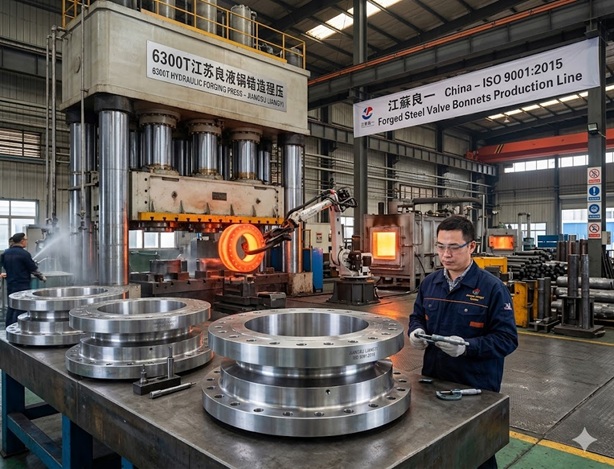
Our forging valve bonnets are manufactured on our 2000T, 4000T, and 6300T hydraulic forging presses, 1T-9T electro-hydraulic forging hammers, with strict control of forging ratio (minimum 3:1, up to 6:1 for critical applications) to make sure they have consistent grain distribution. We provide parts ranging from 30 kg to 30,000 kg per piece,and they are suitable for both one piece sample orders and large-volume mass production oreders.
Advanced Heat Treatment Process
Our forged valve bonnets go through normalizing, annealing, quenching, tempering, and solution treatment in our 10 fully automatic, computer-controlled heat treatment furnaces. The heat treatment process is strictly controled according to material grades and application requirements, to get the great mechanical properties (tensile strength, yield strength, hardness, impact toughness) needed by international standards and customer specifications.
Comprehensive Surface Treatment Capabilities
We fully process our forging valve bonnets to make sure they high strength, corrosion resistance, and performance under harsh mining and industrial conditions.Available surface treatments include electroless nickel plating (ENP), hard chrome plating, tungsten carbide coating, as well as Inconel, Monel and stainless steel cladding.We test all surface treatments very carefully for adhesion, thickness, and corrosion resistance to make sure that all parts will work well for a long time.
Quality Control & Inspection Standards for Forged Valve Bonnets
Our forged steel valve bonnets meet international industry standards, and they are strictly controled in whole process from raw material incoming inspection to finished product delivery. Our main production and testing standards include:
- ASTM A370: Standard Test Methods and Definitions for Mechanical Testing of Steel Products
- ASTM A751: Standard Test Methods, Practices, and Terminology for Chemical Analysis of Steel Products
- ASTM E112: Standard Test Methods for Determining Average Grain Size
- ASTM A668: Standard Specification for Steel Forgings, Carbon and Alloy, for General Industrial Use
- API 6A: Wellhead and Christmas Tree Equipment Specification
- API 8A/8C: Drilling and Production Hoisting Equipment Specification
- ASTM A388/388M: Standard Practice for Ultrasonic Testing of Steel Forgings
- NACE MR0175/ISO 15156: Petroleum and Natural Gas Industries—Materials for Use in H2S-Containing Environments in Oil and Gas Production
- PED 2014/68/EU: European Pressure Equipment Directive
Non-Destructive Testing (NDE) Requirements
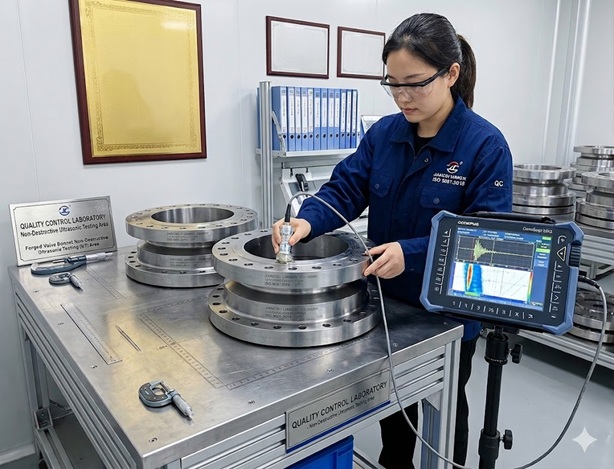
All finished forged valve bonnets are tested in our in-house testing laboratory. The acceptance criteria fully meet all requirements of API 6A, ASTM A388/388M and other relevant international standards.
Ultrasonic Testing (UT)
- Full UT inspection is mandatory for all forging valve bonnets after heat treatment (excluding stress relief treatments or re-tempering for hardness adjustment)
- UT examination is done in strict accordance with ASTM A388/388M, ASTM E127, and ASTM E2375
- DAC Calibration Standards: 1.6mm flat-bottom hole for thickness ≤38.1mm; 3.2mm flat-bottom hole for thickness 38.1mm-152.4mm; 6.4mm flat-bottom hole for thickness >152.4mm
Additional NDE Testing
- Visual Inspection (VT): 100% surface inspection for cracks, porosity, and surface defects
- Penetrant Testing (PT): Full surface inspection for linear and surface-breaking defects
- Magnetic Particle Testing (MT): For ferromagnetic materials, full inspection for surface and near-surface defects
- Hardness Testing: Full batch hardness verification to make sure all parts meet material and standard requirements
Final Finished Product Inspection
Every batch of our finished forging valve bonnets must pass full inspections by our in-house QC department before delivery, including:
- 100% visual and external surface examination
- Dimensional tolerance and marking verification (full compliance with customer drawings)
- Chemical composition analysis (full traceability with MTC)
- Mechanical property testing (tensile strength, yield strength, elongation, impact toughness)
- Metallographic and macrostructure examination
- Residual stress measurement (for critical applications)
- Full non-destructive testing (UT/PT/MT as required)
Global Application Cases of Forging Valve Bonnets
Our high-performance forging valve bonnets are used in extreme industrial conditions across more than 50 countries, and they have great performance in harsh and extreme working conditions. Our main GEO-targeted application cases include:
Middle East Oil & Gas Wellhead Projects (Saudi Arabia, UAE, Kuwait, Iraq)
Our forged steel valve bonnets, manufactured in accordance with API 6A and NACE MR0175 requirements, forged steel valve bonnets are used in high-pressure wellhead Christmas tree systems and manifold valves for onshore and offshore sour gas fields in the Middle East. These forging valve bonnets are made compatible with Saudi Aramco, ADNOC, and Kuwait Oil Company (KOC) technical requirements, with premium materials including ASTM A694 F60, A182 F91, Inconel® 625, and duplex steel UNS S32750, they have excellent resistance to H2S corrosion, high temperature up to 450℃, and high pressure up to 15000PSI. So that work reliably in extreme oilfield conditions. We have supplied forged valve bonnets for major oil & gas projects across the Middle East region with a strong track record of customer satisfaction.
European Petrochemical & Power Generation Industry (Germany, Italy, France, UK)
We supply forged valve bonnets to petrochemical plants, thermal power stations and renewable energy projects across Europe.
Manufactured from 1.7225 (42CrMo4), 1.4313 (F6NM), 1.4462 (2205) and Hastelloy® C276,
they fully comply with the EU’s stringent pressure equipment safety standards. You can also get a full EN 10204 3.2 MTC and an optional TÜV/BV third-party inspection. These valve bonnets can handle extreme temperature changes and corrosive chemicals. They are used in steam control systems, chemical reaction vessels, and pipeline valves. They keep power generating units with 300MW+ and large petrochemical complexes running smoothly.
North American Oil & Gas & Chemical Industry (USA, Canada)
Our forged steel valve bonnets, manufactured in accordance with ASME B16.34 and API 6A requirements, forged steel valve bonnets are used for onshore shale gas projects, offshore oil platforms, and chemical processing plants in the United States and Canada. They are manufactured to ASTM and ASME standards, using materials including ASTM A105, A182 F316L, F22, and Inconel 718. And these forging valve bonnets meet the strict quality and safety requirements of the North American market, with full material traceability and optional ABS/API third-party inspection. They are used for wellhead equipment, pipeline transmission systems, and refinery valves, and work well in high-pressure, low-temperature, and corrosive working conditions.
Asia Pacific Marine & Power Generation (Indonesia, Malaysia, Thailand, Australia)
Our corrosion-resistant forging valve bonnets are used in offshore marine engineering, seawater desalination plants, thermal power plants, and mining projects across the Asia Pacific region. For marine and seawater applications in Indonesia, Malaysia, and Thailand, we use duplex steel UNS S31803/S32750, 316L stainless steel, and Monel® 400. These materials have great seawater corrosion resistance and anti-biofouling performance, fully meet marine industry standards (ABS, DNV, LR). For Australian mining projects, we supply heavy-duty forged valve bonnets made from high-strength 4140/4130 alloy steel, and they are used for withstand abrasive slurry, high-impact loads and harsh underground mining conditions.
Custom Forging Capability & Ordering Process for Forged Valve Bonnets
As a professional maker of custom forging valve bonnets, we can make different custom solutions to fit the needs of your project. Here are some of the things we can do for you and how to order them:
- Full Customization Based on Drawings: We can make forged valve bonnets according to your official 2D/3D drawings, technical specifications, and material requirements
- Flexible Processing States: We can supply products in fully forged, heat treated, rough machined, semi-finished, or finish machined states, according to your processing needs
- Wide Size & Weight Range: Single-piece weight is from 30KG to 30,000KG, maximum diameter is up to 2000mm, fully meeting the needs of small and large-scale applications
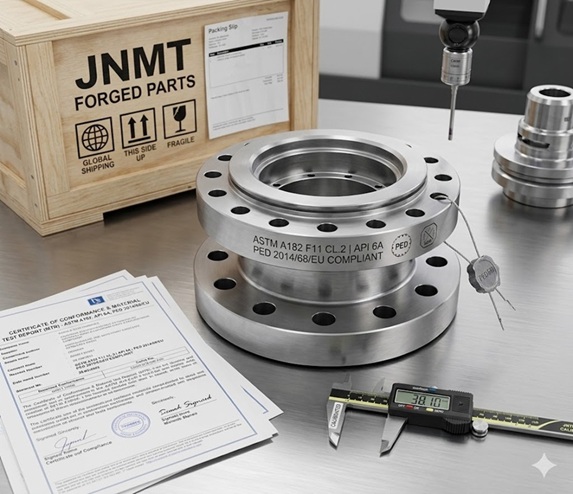
- Full Certification Support: We provide EN 10204 3.1 / 3.2 MTC, ISO 9001:2015 certification, third-party inspection reports (BV, SGS, TÜV, ABS, DNV), and PED/CE certification can be arranged through authorized third-party inspection bodies upon request.
- Lead Time: The usual lead time is 15 to 30 days, but we can speed up production for urgent orders.
How the Custom Forged Valve Bonnet Ordering Process Works
- Send drawings or specifications: Share valve type, bonnet geometry, pressure class, material grade, machining status, and target standard.
- Engineering review: Our technical team checks forging feasibility, machining allowance, heat treatment route, and inspection scope.
- Quotation and confirmation: We check material route, testing plan, delivery schedule, certificates, and commercial terms before production.
- In-house production and inspection: Melting, forging, heat treatment, machining, marking, and NDE are completed under traceable process control.
- Final documentation and shipment: Buyers get inspection records, MTC, dimensional reports, and shipment support for global projects.
RFQ Checklist: Information That Helps Us Quote Faster and More Accurately
To preserve technical accuracy while reducing back-and-forth communication, buyers are encouraged to provide the following details with the inquiry.
- Valve type and bonnet design
- Material grade or approved alternatives
- Pressure class and design temperature
- Corrosion environment, including sour service if applicable
- Required delivery condition: forged, heat treated, rough machined, semi-finished, or finish machined
- NDE scope such as UT, PT, MT, RT, hardness, or third-party witness inspection
- Certification requirement including EN 10204 3.1 / 3.2, PED, CE, or project-specific documents
- Order quantity, target lead time, destination country, and shipping preference
Explore our full range of forged products on our Products page, and learn about our full material grades on our Materials page.
Frequently Asked Questions (FAQ) About Forging Valve Bonnets
What standards do your forging valve bonnets meet?
Our forged steel valve bonnets fully meet international standards including ASTM, ASME, API 6A, API 8A/8C, EN, DIN, JIS, PED 2014/68/EU, and NACE MR0175/ISO 15156. All parts also meet custom standards according to your project requirements.
What is the difference between forged and cast valve bonnets?
Forged valve bonnets have a consistent grain distribution through solid-state plastic deformation, so that they have 30% higher tensile strength, fatigue resistance, and impact toughness than cast counterparts. They also eliminate porosity, shrinkage, and inclusions common in casting, ensuring 100% leak-proof performance for high-pressure, high-temperature, and critical safety applications.
Can you provide custom forged valve bonnets according to our drawings?
Yes, we specialize in custom forging solutions. We can make forging valve bonnets exactly to the client's 2D/3D drawings, material specifications, and technical requirements.
What is the best material for forged valve bonnets in sour gas service?
We suggest using the materials that meet NACE MR0175/ISO 15156 for sour gas (H2S) service. These include low-alloy steel ASTM A694 F60, duplex steel UNS S31803/S32750, and nickel-based alloys Inconel® 625. These materials are very good at resisting hydrogen-induced cracking (HIC) and sulfide stress cracking (SSC).
What NDE tests are required for API 6A forged valve bonnets?
For forged valve bonnets manufactured in accordance with API 6A, mandatory NDE tests include 100% Ultrasonic Testing (UT) after heat treatment (excluding stress relief or re-tempering for hardness adjustment), Visual Inspection (VT), and Penetrant Testing (PT) / Magnetic Particle Testing (MT) for surface defects. Additional tests such as Radiographic Testing (RT) can be provided according to your project requirements.
What is the lead time for custom forging valve bonnets from your factory?
The usual lead time is 15-30 days. We also can speed up production for urgent orders, with a lead time of only 7-10 days.
Can you supply forged valve bonnets in rough machined or finish machined condition?
Yes. We can supply forged valve bonnets in fully forged, heat treated, rough machined, semi-finished, or finish machined condition according to your processing route and assembly requirements.
What information should I send for an accurate forged valve bonnet quotation?
Send us your 2D or 3D drawings, the material grade you need, the type of valve you need, the pressure class, the working temperature, the machining condition, the testing scope, the certification requirements, the quantity, and the delivery schedule you want so we can give you a faster and more accurate quote.
Need a quotation for forged valve bonnets?
To get an accurate quotation,please send us the bonnet drawing, material grade, valve type, working pressure, temperature range, NDE scope, certificate requirement, order quantity, and preferred delivery condition. Our engineering team will respond to you as soon as possible.
Contact Us for a Free Custom Forged Valve Bonnet Quotation
Jiangsu Liangyi Co., Limited is your trusted China-based manufacturer and supplier of high-quality forging valve bonnets, with over 25 years of experience serving global industrial clients. We are ready to provide you with competitive pricing and professional forging solutions based on your specific requirements. Welcome to send your custom drawings, material specifications, and quantity details for a free detailed quotation!
Inquiry Email: sales@jnmtforgedparts.com
Phone/WhatsApp: +86-13585067993
Website: https://jnmtforgedparts.com
Address: Chengchang Industry Park, Jiangyin City, Jiangsu Province, China